Saturday, October 16, 2010

Sonic 4 vs. Sonic Genesis Games (A Design Analysis)


(It's been a while since I've made a blog post and I still have some Japan ones backlogged but I wanted to write this one while it's still fresh and relevant.)

Sonic 4: Episode 1 was released a little while ago and it's been receiving mixed reactions. Some say that it is truly a step in the right direction for Sonic while others say that the game's issues prevent it from being a redeeming outing for the hedgehog. I downloaded it and have been playing it on my Wii and I wanted to do a little design analysis of it compared to the original games that debuted on the Sega Genesis. I don't mean for this to be a game review, although it may be used as one. I hope to compare and contrast some of the elements from Sonic 1, 2, 3, and Knuckles to those in Sonic 4. I will also try to offer some changes that might make Sonic 4 more of the "New Super Mario Bros. for Sonic" that fans have been clamoring for.

A Return to Sonic's Roots
Sega had a great concept when coming up with Sonic 4: making a new Sonic game with classic gameplay elements and throwbacks to the old games. Fans (me included) thought this was great; finally, a Sonic game that's won't be terrible! Of course, there was the Sonic Cycle in the back of our minds, telling us that this is just another game that will be overhyped and that will never live up to our expectations. Some fans embraced and accepted the Sonic Cycle, saying that no Sonic game that Sega puts out will ever be good. Ever. Well, Sega became aware of the Sonic Cycle and were determined to break it. Sonic Colors, a new 3D Sonic adventure, will be out in November and may break the cycle (or so they say).

But was Sonic 4 able to finally do away with the Sonic Cycle? Yes and no, in my opinion. While Sonic 4 was able to do away with useless game mechanics, superfluous new characters, and silly storylines, it didn't quite fully capture the essence of the original Genesis games. Sega did an excellent job reimagining classic enemies and level design, but they missed with the physics and overall feel of playing a classic Sonic game. Sonic doesn't seem to move as he would have in the original games, and it's confusing how they could have neglected this key part of the game. Some of the level art seems overly gaudy as well, and some of the music, while having a familiar sound, doesn't have the same magic that the Genesis tunes did (maybe it's the lack of assistance from Michael Jackson?). Nevertheless, Sonic 4 is an enjoyable game that fans and newcomers can both have fun with; it's just not the Sonic game that it could have been.

Who is the Target Audience?
A common game design question that is asked is "Who is the target audience? Who are we making this game for?" Sega had a few different options for this question. They could have taken the route Capcom did with Mega Man 9 & 10 and restricted the target audience to the hardcore players and fans. This would have been the best option if they had wished to please only the hardcore by using sprites and 8-bit music, but they would have neglected the rest of the gaming audience. Instead, Sega took the "safer" route (from a marketing standpoint) and made Sonic 4 accessible for all players. This is evident by the 3D graphics and the stage selection screen, which lets you choose specific stages as well as special stages.


If Sega really wanted to make it a true classic, they could have opted for 2D sprites over 3D art, and made chiptunes instead of newer music that borrows 8-bit elements. They could have also eliminated the stage selection screen all together and just made the level progression linear like in the Genesis games. (They could have also gotten rid of saving if they were super hardcore.) It's understandable that today's games should be made for today's audience rather than yesteryear's, but it seems like fans would want something more geared towards the past than the present. In my opinion, these aesthetic choices can be overlooked by focusing on the main gameplay of the game.

The Mechanics Matter
So what about the gameplay? The basic elements take off from where Sonic 3 (& Knuckles) left off. Sonic can run (obviously), jump, and spin dash. He has also gained the Homing Attack that was introduced in Sonic 3D Blast, which is a rather decent addition. The controls are simple and familiar, which helps fans feel at home and allows new players to jump right in. The main issue, however, (which has been noted by many reviewers and players) is Sonic's physics in the game. There are several quirky problems which seem to stem from the apparent lack of inertia. Sonic will stop immediately if the player is not holding down a directional, especially during a spin dash or while Sonic is in the air. This flies in the face of hardcore players' expectations; Sonic is supposed to be somewhat "slippery" and glide over slopes easily instead of stopping dead. There are also some issues with running fast vs. spinning that just don't feel right. These issues can be ignored to an extent, and it is possible to enjoy the game despite these flaws. Classic players will be fairly annoyed with these inconsistencies to the Sonic gameplay of the 90's.

In terms of level design, Sega managed to deliver. The level layouts are very reminiscent of the classics and don't merely focus on pure speed (some people complain about the excessive placement of speed boosters, but I found them to be sparse enough to not be a problem). Multiple paths and hidden routes and items are a definite plus that are consistent with the Genesis style. I even found that the "cheap" enemy placement in some levels (where you are almost guaranteed to be hit and lose all your rings) to be somewhat reminiscent, albeit annoying. Some areas seemed dependent on the incorrect physics, which could be tweaked if the physics were changed. One instance was the mine car track in the Mad Gear Zone, where at one point you would fall to your death if you weren't holding right on the D-Pad. If the mine car is moving on it's own, how should I know to hold a directional? Where's the inertia? Even with these minor flaws, the layout of the levels is definitely something that was done right.

Sega, notorious for adding too many mechanics into Sonic games (Sword fighting? In my Sonic game?), managed to keep the mechanics fairly basic in Sonic 4. Sonic himself was only given the additional Homing Attack, and the levels maintained a good level of unique mechanics. Some of the level mechanisms are borrowed from the old games, like the teleporting tunnels from the Metropolis Zone and the slot machines from Casino Night, but others are brand new, like the swinging vines in Splash Hill. Zip-lines and running-powered gears are reimagined level mechanics that make Sonic 4 new but traditional. Of course, loops and springs are a main aspect of the level design, and rings are placed just where you would expect them.


One design that I don't agree with is the special stages. Sega decided to reinvent the special stage from Sonic 1, this time allowing the player to control the rotation of the stage directly. Sonic 1's special stage was the worst of the three, in my opinion; it didn't give the player enough control and seemed more luck-based since they couldn't really directly control Sonic. In Sonic 2 and Sonic 3/Knuckles the outcome of a special stage was directly effected by the players actions and they could directly control Sonic: the player needed to collect enough rings in Sonic 2's stage and all the blue spheres in Sonic 3's stage to be awarded the Chaos Emerald. Sonic 4 combined these two ways of attaining a gem by allowing the player to control a maze similar to a Sonic 1 special stage and unlocking doors when the player collected enough rings. I feel that a special stage where the player directly controls Sonic to complete a task to get the Chaos Emerald would have been more effective, rather than have him bounce around a maze, but that's just my opinion.

The Nostalgia Factor
In a game targeted at all players, how to you please the hardcore? Obviously, the core of the game should be easily recognizable and familiar to hardcore players while being accessible to newcomers. Sega was successful in making a game that everyone could play and enjoy, but the faulty physics detract from a hardcore's complete enjoyment of the game. Another way to please longtime fans is to insert little nuggets of nostalgia into that game. Sega was pretty successful with this aspect of the game, but they could have done much more. I'm fairly sure that all the enemies were borrowed from the Genesis era, with a few new twists. The level themes are almost direct copies of old Zones: Splash Hill is the obligatory Green/Emerald Hill; Casino Street is the popular Casino/Carnival Night; Lost Labyrinth is pretty much the Labyrinth Zone from Sonic 1; Mad Gear is the Metropolis Zone from Sonic 2. Some of the sound effects are directly taken from the classics, most notably the 1-Up sound effect from Sonic 3 and the sound played when getting a Continue. I would have liked to hear the "warp" sound when entering and leaving a special stage, but that's the only one I could think of that was missing. As mentioned earlier, the music sounds like it belongs, but doesn't quite capture what the original themes had. They pull from old songs and have familiar sounding parts but they aren't as lively as some of the music from, say, Sonic 3.

One of the major ways Sega could have improved the nostalgia factor would have been to make the entire game 2D with sprites instead of 3D models. Capcom was successful in doing so with Mega Man 9 and 10 and I think Sega would have experienced similar success by following suit with Sonic 4. Like I said before, this may have shrunk the audience, but the hardcore gamers who did buy it would have thought more highly of it. It is really a debate over sales numbers and the impact of the game on classic fans, and Sega seems to have chosen the former. The impact of this decision may be small, but it is still a noticeable decision among fans. It may seem illogical to make such a large art decision for a small subset of the audience, but it's possibly that Sonic 4 could have been received with more open arms if it had been 16-bit.

Anyone who has played Sonic 1/2/3/Knuckles to an extent will be able to pick out the nostalgia elements from Sonic 4, but the hardcore fans will feel uneasy with this new outing because of the faults mentioned previously. The artifacts of the present that exist in Sonic 4 convince fans that Sonic will never reclaim his previous glory that he experienced in the 90's. But why does he have to? Why can't Sonic evolve to fit into today's game industry as Mario has? I believe that he can, although it will take some convincing of the fans from Sega.

Where to Go From Here
Since Sonic 4 is episodic, Sega has a chance to learn from the fans' response to Episode 1 and address the issues in Episode 2. There isn't a final count of how many episodes there will be, but hopefully Sega will be able to distill the gameplay with each iteration into a pure Sonic formula that can be used in future games to finally redeem Sonic. As long as Sega listens to the fans and uses the iterative process with each new Sonic game, Sonic will be able to rise through the ranks to a place where he once stood proud.

(That's it for now. I may edit this later if I think of anything else, or if there are some glaring issues.)

Friday, September 10, 2010

Back to a Historical City (9/4/10 & 9/5/10)

In an attempt to see the sights we missed in Kyoto, we went back twice (in two different groups) and saw a couple of new things. On Saturday we visited Ginkaku-ji, the "Temple of the Silver Pavilion", and on Sunday we visited the Iwatayama Monkey Park and the Arashiyama bamboo forest.

September 4th, 2010: As with most of our weekend trips this trip was planned at the last minute, so we travelled to Kyoto without any real itinerary (other than wanting to see Ginkaku-ji and Kinkaku-ji). Unfortunately, we only made it to Ginkaku-ji, but we had a nice time walking around the garden area and taking lots of pictures. Both Ginkaku-ji and Kinkaku-ji closed at 5:00PM; we were at Ginkaku-ji at around 4:30PM and would not have been able to travel to Kinkaku-ji before it closed.

* * *

September 5th, 2010: Learning from our previous error of leaving in the afternoon, some of us left a few hours earlier (closer to 12:00PM) and headed to Arashiyama, with the bamboo forest as our destination. On the train ride there we noticed that the Iwatayama Monkey Park was close to the station and on our way to the bamboo forest. We ended up taking the wrong path up the mountain, however, which was in actuality a hiking trail that didn't lead to the park. We spent a chunk of time hiking part way up and then back down after we noticed our phone's GPS straying from the Monkey Park, but after walking a short distance from the entrance of the trail we found the entrance to the Monkey Park.

The Monkey Park, also known as "Monkey Mountain", houses around 150 monkeys that are all named and all have their birthdate recorded. The park has certain rules, such as "Don't stare at the monkeys in the eye" and "Don't touch the monkeys", but you are able to feed them with snacks bought at the top of the mountain. The monkeys are used to human visitors so they frequently walk close to visitors and usually stay still for pictures. One baby monkey actually walked to me and started playing with my shoelaces, but I snuck away when it wasn't looking so that I wouldn't upset its parents. The view of Kyoto from the top of the mountain is also really nice, and there are a few sets of build-in binoculars for viewing the many buildings down below.

After leaving the Monkey Park we crossed the Togetsukyō bridge and walked only a short distance to get to the bamboo forest. The tall stalks of bamboo were quite intimidating but are a really interesting sight to see. They sway in the wind and drop leaves like confetti, and even block out some of the sunlight as you get deeper into the forest. The trail through the forest is fairly long, and there is a path that leads up to a garden made by a famous film maker (if I recall correctly). We stayed on the main path but I don't think we went all the way through. After exiting the forest we took a snack break at a small stand and walked back to the train station, walking along the river and back across the bridge.

(Check out all of the Kyoto photos from this trip here!)

It looks like our next weekend destination is to Himeji to see what is apparently the best castle in Japan. Then after that, it's time for the Tokyo Game Show and more Tokyo sightseeing!

Thursday, September 2, 2010

A Little Slice of Tokyo (8/23/10 - 8/27/10)

Soon after the lab trip we travelled to Tokyo for the IVRC Finals at Miraikan. Our side project that we've been working on since before we arrived in Japan made it to the finals, so we were able to present it at the conference in Tokyo. The conference itself was three days, Monday to Wednesday, but we stayed for the rest of the week to look around and to climb Mt. Fuji. We stayed in a fairly nice hotel on Tokyo Bay with a beautiful view of the city, including Tokyo Tower close by. The hotel was also a five minute walk from the Pokémon Center, which was a nice perk.

August 23rd-25th, 2010: The three days that we spent at Miraikan for the IVRC were fairly regular. Monday was set-up and Tuesday and Wednesday were presentation to the public. Our project was パランガ (Paranga), the Virtual Flipbook. As the name implies, it was a device that simulated page flipping and animation that you get with a flipbook. We had some issues with our device throughout the event, and only one worked for half of it, but we were able to show it off without any major issues. There were some official judges going around and taking notes who decided which awards would go to which project. There were also boards where visitors could place stickers for their favorite project. At the end of the second day the main awards were announced, and at the end of the third (last) day the winners of the "audience choice" awards were announced. We ended up winning the Maywa Denki President's Award (presented to us by Maywa Denki himself), which I feel like was more of an "honorable mention" than a real award. There wasn't a monetary prize, just a certificate and an odd musical instrument called an Otamatone. It was still better than what I was expecting, which was nothing! It was cool to see the different types of projects that other people brought to the conference, especially since we were pretty much thrust into this project without any background of the contest. I think we did pretty well, given the circumstances.

* * *

August 25th, 2010: After the IVRC was over, we decided to walk around for the rest of the night to visit some local places. Obviously, the first place I wanted to go was the Pokémon Center, and we walked there first since it was close to the hotel. The store itself seemed smaller than the one in Osaka but had much of the same merchandise. The one thing that stuck out was the table for playable demos of the new games, Pokémon Black and White. There weren't many people/kids in the store or at the demos because the store was closing in less than an hour, so I was able to hop on one of the DS systems quickly and play without the pressure of other people in line. I really enjoyed what I saw and played, and I definitely will be purchasing a Japanese copy when it comes out on September 18th.

After eating ramen at a small restaurant for dinner, we debated whether we should go back to the hotel to plan our Mt. Fuji trip or take the monorail to the large mall and SEGA Joypolis that we discovered the night before. Although, in retrospect, it would have been better to plan out our Fuji trip I have no regrets about our choice to check out Joypolis. At first, I assumed that it was merely an arcade with a few rides like the one in the HEP Five building in Umeda, but I was only partly correct. Joypolis is a 3-floor amusement park with about 20 rides, many arcade games, and some gambling games. Unlike the one in Umeda, this Joypolis has some large rides, including a fake snowboard halfpipe and a small roller coaster. There are also some "virtual reality" games, like racing and shooting games. We were totally surprised when the giant entrance doors opened and we walked inside because we were not expecting it in the slightest. At first, the ¥1,900 discount ticket still seemed expensive, but I think it was worth every yen.

* * *

August 26th & 27th, 2010: On Thursday we started our day fairly early to travel to Shinjuku where we would catch a bus to the Mt. Fuji area. Instead of resting up for our hike we made the mistake of walking around Shinjuku looking for arcades. We found several of them and played some games which was nice, but all that walking left us tired and not fully prepared for our Fuji encounter. The games I played were the usual Rhythm Heaven game, DrumMania (which was much harder for me than Rock Band drums), GuitarFreaks, and Mario Kart Arcade GP 2 (I actually printed my "license" card this time for ¥200 extra).

After visiting the ¥100 Shop, waiting a little while for our bus, and riding the bus for about 2 hours, we arrived at the 5th station on Mt. Fuji. This station is one out of the 9 that are located along the trail to the summit, and most climbers start here and continue to the top. I started the hike in my usual clothes (shorts and t-shirt) because I enjoyed the cool weather that we experienced due to already being about 2,000m up the mountain. As we got closer to the top, I resorted to putting on my sweatshirt but I kept on my short for the entirety of the hike. I don't remember much of the hike up because it was really repetitive and dark, plus I was already tired and mainly focused on climbing rather than thinking about anything else. We took frequent breaks along the way, and we took the time to look back down the mountain at the clouds and other hikers, up at the distance we still had to travel, and up at the stars we wouldn't have been able to see from the city. As we got closer to the top it got harder and harder because of the lack of sleep, lack of energy, and lack of oxygen. Somehow, we managed to make it to the top (and at that point I didn't actually know it was the top) and were able to rest for a bit before sunrise, despite the biting cold and supreme exhaustion.

The sun rose at about 4:30AM and we had the best seats in the house (3,776m about sea level). Instead of seeing it rise above the ocean or normal horizon, it seemed to rise out from the clouds, illuminating everything as it found its place in the sky. Once it was up we could truly see all of the clouds and smaller mountains surrounding Mt. Fuji and the actual number of people that were on the summit. We took some time to take pictures around the crater but didn't stroll around the top to look around because we weren't really in the mood to do anything other than go back home. We had been climbing for about 7 hours and were not looking forward to another 5 hours of walking back down. The descent sounds like it should be easier than climbing up, but it was probably just as difficult because of the steep slope and tiny rocks that afford slipping. I witnessed a few people falling and slipped many times myself. It was not an enjoyable experience in the slightest, but the view of the clouds and mountains below us helped make it better. At one point near the end of the descent, the clouds were actually sweeping up the mountain and onto the trail, giving us a refreshingly cool breeze that I would have loved to bottle up and take with me. By the time we reached the 5th station again, my knees and feet were killing me and I was covered in a thin layer of dirt from the downward trail. We took another bus back to Shinjuku, travelled back to the hotel to get the luggage we stored there, and waited several hours for our overnight bus back to Osaka (all without sleep...). I was able to pass out on the overnight bus back home, but it took some time for me to get back into my regular sleep schedule. It was a good thing we ended our hike on a weekend!

(Check out all the photos from our Tokyo trip here and here!)

Saturday, August 21, 2010

"A Quiet Mountain Retreat" (8/18/10 - 8/19/10)

Although we staying in last weekend, we were able to join almost everyone in the Takemura Lab on a two-day lab trip out to various places in the Chūbu region of Japan, such as the Gifu and Ishikawa Prefectures.

August 18th, 2010: On the first day of our trip, we woke up early and boarded the bus outside the Cybermedia Center at around 7:30AM. After picking up some more people at the Suita campus, we embarked on a 4 hour ride to Shirakawa-gō. This village is a historic World Heritage site with many thatched-roof houses surrounded by many mountains. It was very hot and sunny while we walked around the village and there were several souvenir shops that sold cold drinks and shaved ice. One of the places we stopped at was a small museum in one of the houses. There were some ceramics and other items on the first floor and many old tools and machines on the upper floors for farming and other tasks. Upon leaving the museum, some of us headed for the mountain viewpoint up an inclined path at one end of the village. From the top, we could see all of the houses and the adjacent mountain in a beautiful panoramic view. We descended from the viewpoint back to the entrance of the village and spent some time at a rocky area by a small river, and then got back on the bus to head to our hotel.

The ride to the hotel took about an hour or two, and it seemed as though our group had reserved half (or more) of the floors of the hotel for our group. The hotel itself was fairly small, but I'm pretty sure we took up most of it. The WPI and UCSD students occupied the 5th floor of the hotel, which was three rooms for 4-5 people each. Shortly after dropping our stuff off in our rooms, we attempted to try out the onsen before dinner but didn't have enough time. Also, since we were awkward American foreigners, we were a little uncomfortable with the Japanese customs surrounding the onsen and decided to try after eating. The dinner was very fancy and obviously pretty expensive. Unfortunately, most of it consisted of seafood so the hotel staff had to make an impromptu non-seafood dinner for me. I felt bad that they weren't informed beforehand, but they were very kind about preparing a separate meal for me. I think my favorite part of it was the tempura vegetables with sea salt. I definitely would like to try some more (non-shrimp) tempura in the future.

After eating, the UCSD students gave brief statements about their stay since it was their last week in Japan and we all headed to the onsen. There were a few different baths with different temperature water in each, ranging from normal swimming pool temperature to scalding hot. We stayed until the hotel started closing the baths, and then went back to our rooms and got ready for bed. The hotel rooms were very traditional, with tatami floors and futons for beds. The futons were extremely comfortable and the blankets were fluffy and heavenly. If there was one thing I wanted to take from the hotel, it was one of those blankets.

* * *

August 19th, 2010: We were told the night before that breakfast would be at 8:00AM, but we stayed up until 3:00AM for no reason and were woken up at 8:05AM by the organizer of the trip. Half-asleep, I picked at my breakfast and afterwards packed up my backpack and got ready for another bus ride to Yunokuni no Mori, a village whose main attraction is the handicrafts that are created there. The first thing we did was paint our own ceramic cups. The cups were supposedly baked to complete them, but at this time we haven't gotten our cups and I'm not sure if we will. We hung out in this village for a bit, walking around and checking out the other shops that were in the area. There was a souvenir shop with other hand-made crafts and a "gold leaf" store with a lot of gold items. We met at the entrance when we were finished walking around and we took the bus up the hill to a very seafood-y restaurant. Luckily, the staff was informed that there were two vegetarian meals that were to be prepared (one for me and one for a UCSD student) so I was fitted with a non-fish meal again.

Following lunch, we took a large group photo with all the trip attendees and boarded the bus to our final destination: the Fukui Prefectural Dinosaur Museum. Prior to the trip, we were asked if we wanted to go to a large temple or the dinosaur museum, and I obviously picked the latter. As interesting and visually intriguing as temples are, we've seen a fair amount of them but haven't seen anything relating to dinosaurs. The museum consisted of 4 floors of fossils and information about Japanese archeological digs and findings. The building was filled with full skeletons of several types of dinosaurs, some smaller fossils of other creatures, and even some moving animatronic dinosaurs. The museum was spectacular and I enjoyed all of it. I thought about purchasing something in the gift shop, but couldn't decide on what would make a good souvenir for myself. Also, I already have some fossils that my amazing girlfriend got me in Morocco. We only spent about an hour in the museum, but that was enough time to see everything that was on display. We boarded the bus after that and headed back to Osaka, which took another 4-5 hours. I'd say the whole trip was definitely worth the ~$270 we paid since we got to visit and see places that we wouldn't have on our own.

(Check out all of the photos from the trip here, here, and here!)

Our next scheduled trip is to Toyko for the IVRC Finals, which we will conclude with a hike up Mt. Fuji! I'll try to take notes during the week (8/23 - 8/27) and compile them into a blog post next weekend (hopefully). I may split the week-long trip into smaller posts, especially since the IVRC Finals and Mt. Fuji hike are fairly separate topics. Anyway, that'll be coming in about a week!

Thursday, August 12, 2010

Osaka Fireworks and Historic Nara (8/7/10 & 8/8/10)

Last weekend we watched some really impressive fireworks in Umeda and took a trip to the historic prefecture of Nara (which had an area that was full of wild deer). It was a lot of walking around (about 20,000 steps each day, according to my Pokéwalker) but I thoroughly enjoyed both days.


August 7th, 2010: Our original plan to watch the fireworks was to see if we could stay at the Umeda Sky Building and watch from the upper floors (and possibly the observation deck). When we got up to the floor with the ticket counter, however, we learned that the Sky Building closed at 6:30PM (fireworks started at 7:50PM) and that they did sell special tickets for watching fireworks from the top. Unfortunately, these special tickets were sold out weeks ago, so we had no chance to follow through with our plan.

For Plan B, we walked to the river where the fireworks were to be launched from and looked for an adequate seat. They were selling tickets for a reserved seating area that was close to the river and had folding chairs but it was ¥5000 per person! Instead, we found a cement slope at the base of a raised area and behind a stretch of grass that had enough room for us to hang out. We sat there for a while playing our portable gaming devices until it got dark, and there were many others playing their DS systems.

The fireworks themselves were superb. There were many different types and colors, and even some shapes like smiley faces and fish. One thing that I had never seen before were fireworks that went off close to the ground. These explosions were coupled with the ones in the sky but appeared only as semicircles on the ground. Lots of people around us would call out the names of the shaped fireworks and also applauded heavily after grand cascades of explosions. After the show, we walked back to the convenience store we passed on the way to the Sky Building and got jumbo franks on sticks for dinner.

* * *

August 8th, 2010: One of the Japanese students that Sarah and Liz are working with lives in Nara and offered to take us all (in two groups) on a tour of the city. Since that group I was with was in Umeda on Saturday we went to Nara on Sunday. Shunsuke, our student guide, picked us up at the Toyonaka campus and drove us to Nara early in the morning (the whole drive took about an hour and a half), with a breakfast break at a rest stop halfway there. The rest stop has a few food places inside, but we all ate at a danish shop called the Little Mermaid. I got a hot dog with onions, a cheesecake-filled ball (pretty much just a big Munchkin), and a chocolate-covered, custard-filled twist. After eating, we traveled the rest of the way to Nara.

Our first stop in Nara was the Isuien Garden, a tranquil area with two ponds, some traditional Japanese houses, and lots of trees and other plant life. There were a lot of pond skaters on the surface of the water, and even a couple koi (or carp) in the ponds. The paths and bridges over the ponds and streams were all made out of stone, which made the entire area seem very natural and peaceful. We also visited the small museum next to the garden which housed mostly historic decorated mirrors and ceramics. From the garden we walked back to the main street, through an underground passage (to prevent pedestrians from crossing the busy street), and to a sidewalk next to a large park. This area was home to a bunch of wild deer that were accustomed to people giving them attention. There were several vendors selling disposable cameras and crackers for deer food. The deer were pretty aggressive when they sensed someone with food, and signs were posted warning visitors of potential harm that deers may cause. We continued out trip by walking for a bit down the street to an area with some temples and pagodas, with deer all along the way.

The main temple in this area is called Kōfuku-ji, and there are many, smaller buildings in the area. Although we didn't go inside the main temple, we pays to view the small national treasure museum nearby and walked around to see the other pieces of architecture. We stopped to get some shaved ice soon after we arrived, and we saw many places that we've become used to from visiting the temples in Kyoto, such as hand-washing stations, hanging wish/fortune tags, and small shrines for praying. Our guide lead us around this area for a bit and then down a few streets with deer and various vendors.

Our next stop was to the famous Tōdai-ji, which houses a huge Buddha statue as well as some smaller statues. Being a popular tourist sight, the temple attracts many visitors and it was no exception when we were there. Some people stopped to burn incense at the beginning of the path leading to the temple and others took photos in front of the building. One interesting fact that we learned from Shunsuke was that the path leading up to the temple was constructed with five different types of stone, representing Buddha's journey to Japan.

From Tōdai-ji we sought a place to eat lunch and then drove to our final destination, Heijō Palace. The entire palace area is massive and includes a gate, a large courtyard, and some small museum rooms that depict the excavation and restoration of the palace. It didn't take as long as I thought to walk from the entrance to the palace, but it looked like it would take forever (especially in the blazing sun). The palace itself houses some informational panels about excavation and restoration, and also has a small throne area in the middle.

Altogether it was a very full weekend and I'm glad that we were able to see one of the several summer fireworks shows while we are here and that we had the opportunity to visit Nara, since we might not have been able to given its distance from where we live. The other places we have in mind for weekend trips are Kobe, which is in the opposite direction of Nara from us, and obviously Tokyo. I'm not sure if we have any upcoming plans to go to these places, but there will be blog posts when we do go!

(Check out all the photos from this weekend here, here, and here!)

Sunday, August 8, 2010

Reach for the Sky Building (8/1/10)

Oops, I haven't updated my blog in a while. I've been keeping busy with lab trips, presentations, and other stuff for the two projects I've been working on for my MQP. Anyway, here's a summary of last week's events.


August 1st, 2010: For the first day of a new month, some of us took a trip to the Umeda Sky Building and some other places near the train station. It was a trip we had been planning on taking for a while, and we finally had a free weekend to visit.

Getting to the Sky Building was easier than we thought. We took the train to the station between Juso and Umeda, and we could see the Sky Building as we got off the train. From the station, we just walked towards the Sky Building until we got to it (which took about 15 minutes or less). At the base of the building there was a large event going on; tents and chairs were set-up, along with a small stage and some penguins (for real). There was a small pool with a penguin swimming around in it and another penguin standing on a small table surrounded by blocks of ice. The penguin on the table wasn't very happy to be there, judging by how it pecked anyone who pet it (its beak was taped so that it wouldn't bite anyone). We pet the penguin and continued on,wondering what the heck this event was. We soon learned that it was some sort of Michael Jackson event, which didn't help us understand why there were penguins, but they seemed to fit in for some reason.

To get to the top two floors and roof observation deck, we had to take escalators up to the 3rd floor, an elevator up to the 36th floor, and then a big escalator to the 39th floor. Access to the top floors costs ¥700 but it's totally worth it. The 39th and 40th floors have out-facing windows with a great view, and there's an even better view from the observation deck. There are pictures on the inner walls of other "sky" buildings, such as the Empire State and Chrysler Buildings in New York (classified as "Sky Musical"). On the roof there are signs for the cardinal directions and large fences for preventing falling customers. One segment of the roof is the Lumi Deck, were lovers can sit at night and be illuminated by the city lights. The surrounding fence is covered in heart locks that represent the promise of a loving couple. I'll definitely be going back someday, but not by myself. When we were done at the Sky Building, we took an underground path that led back to the Umeda train station. We passed the first First Kitchen we ate at and the Yodobashi department store on our way towards the station, which let us know that we weren't lost.

Our next two stops of the day were the Pokémon Center - Osaka in the Umeda Center Building plaza and the HEP Five department store. Of course, I was super excited to be going to a Pokémon store in Japan and we finally made it! Unfortunately, one of the stickers on the window said no cameras so I wasn't able to take any pictures of the cool stuff inside. Out front there was the "Pokéwalker Corner", where you connect your Pokéwalker with a staff member, scratch a scratch ticket, and get a small item for free. I got a small plastic folder with the Generation II Pokémon on it. There was also an automatic gifting machine inside that sent an item to your Pokéwalker when you connected with it. I'm not sure what the criteria for obtaining items is, but I got TM 34 (Shockwave). We looked around for a bit at all the cool stuff they had; there were t-shirts, plushies, cookware, game-related items, toys, and lots of other Pokémon goods. When we were finishing up looking at stuff, a timid Japanese teen who came up to me and connected her two Pokéwalkers with mine, and her Nidoking and Nidoqueen met up and play-battled with my Furret. I will definitely be returning to the store to purchase souvenirs for people (and myself) at some point before October.

Our last stop of the day was the HEP Five department store that we kept seeing and hearing about. It's hard to miss, what with having a large red ferris wheel on top. The building itself has 9 floors, with the first 6 being mostly clothing stores (and as a result, being filled with lots of young women). The 7th floor has some food stores and access to the ferris wheel, and the 8th and 9th floors are devoted to Joypolis, a SEGA-owned arcade and amusement area. Of course, we headed straight to the top to see the arcade which didn't disappoint. Not surprisingly, the likenesses of Sonic and his friends are posted everywhere, from change machines to height-requirement signs. There are several "rides" inside the amusement area which we didn't explore (they were ¥600 each for admission) but one was a hanging cab that moved into a room with a large movie screen to simulate an adventurous flight similar to those virtual roller coaster machines. Another ride involved riding in a car and shooting things around you, but I don't know if it was simulated via screens or was an actual ride like those in Disney World and Universal Studios in Florida. I got to play two games in the arcade: the arcade version of Rhythm Heaven and Mario Kart Arcade GP. Each game was ¥100 which isn't too bad; Rhythm Heaven allowed three games to be played and Mario Kart allowed one race.

After I played Mario Kart, we went down to the 7th floor and bought tickets for the ferris wheel. It costs ¥500 per person and each ride is about 15 minutes each. When we were there the ride was pretty empty, as were the lines to get to the ferris wheel. We were able to purchase tickets and instantly hop in a car. One of the cool things about the ferris wheel cars is that there is an iPod dock behind the seats on one side. Luckily, I had my iPod Touch on me and was able to put on some Sonic music from the Genesis era. There were also stickers on the windows on four sides to tell what sights could be seen from the ride. From where I was seated, I could see the Sky Building and the Namco arcade that we saw a few weeks ago but didn't end up visiting. We had actually planned to visit the Namco arcade while we were in the area, but after the ferris wheel ride everyone was ready to head back home. And once the ferris wheel ride was over, we did just that. Overall, the trip was a success and we learned that there are some cool places worth revisiting that are not too far from where we live.

(Check out all the photos from our trip to Umeda here!)

(Next time: Fireworks and a trip to the historic city of Nara! Coming soon!)

Thursday, July 22, 2010

Going, Going, Gion! (7/16/10 & 7/17/10)

The Gion Matsuri is a month-long festival that takes place in Kyoto each year, and we were able to get a glimpse of it on Friday the 16th and Saturday the 17th. There were a lot of vendors selling a variety of foods and a lot of impressive floats in Saturday's parade. Of course, there were also a ton of people walking around, so it was very crowded.

July 16th, 2010: In order to spend a decent amount of time at the festival, we left the lab at the university much earlier than usual. When we got to Kyoto it was starting to rain, but luckily we all brought our umbrellas (the big 525 Yen one I bought at the university store really came in handy). Near the exit of the train station we could see a lot of people and one of the lantern-covered floats. We walked around a bit and came across a street that was lined with many types of vendors. They were selling things like candy apples, children's masks, and shaved ice and some of them were (obviously rigged) lotteries to win video games and systems. After taking a short break to decide what to do, we continued down the decorated streets towards another one of the floats. What we didn't know what that people were crowding the street to line up to look inside the float, and we were stuck in a mass of people for quite a while. It was quite uncomfortable and not the best start to the trip, and it made New York City during Christmas time seem like an empty parking lot.

We escaped the packed street and took a turn down one a street that was part of the Teramachi-dori shopping plaza. There were also crowds of people here, but they kept moving for the most part. This street consisted of many storefronts, most of which were selling fresh fish and other related foods. There were some general convenience stores and souvenir shops, too. This street stretched on for a bit, and intersected another wider one with different shops. There was a lot more variety on this street; there was a coffee shop, t-shirt store, clothing store, and even an arcade (that we didn't find until the next day). Some of us went to check out the crane-game arcades, but they didn't have any regular arcade games. The second floor of one of them had a few music games, but they were in a tiny, dimly-lit room.

At the end of our walk through the shopping area, we came out near a busy street and wanted to look for a place to have dinner. There were several places along the street and we ended up stopping in a place called Yayoiken. In this restaurant, you order your food from a vending machine: you put in your money, select a menu item, and the machine gives you a ticket. When you are seated, you give the ticket to the waitress/waiter and they bring out your food when it's ready. Everyone else got the steak meal that was advertised out front, and I ordered a plate with two hamburger patties, two small hot dogs, and a piece of fried chicken over onions and bean sprouts with a tasty sauce. All of the meals came with soup, a cabbage salad, and rice and everything was delicious.

After dinner we made our way back to the streets we traversed before and found a long, wide street with lots of vendors on it. All of the stands were lit up, and there were many duplicate stands (in case you missed the first one you saw). This street was pretty crowded, but not as bad as the ones earlier in the day. Some of us stopped to get snacks, and I got cotton candy and melon shaved ice on our walk down the street. The lantern floats that we saw before were now lit up, too. Since it was getting late, we made our way back to the train station and went home.

* * *

July 17, 2010: We got up nice and early to catch the parade, and we managed to see some of the floats up close. There were lots of people crowded at the edge of the side walk but we managed to get close enough to take some nice pictures. Two types of floats were displayed at the parade: small ones with famous people on top and a bunch of dressed-up marchers around them, and huge floats with giant wheels and tall tops being pulled by many people. The people in the large floats rang bells and chanted, while the men on the front waved fans around and shouted when the float moved forward. It was an interesting sight and was pretty impressive to see the big floats being turned at street intersections (flattened bamboo is put under the big wheels and the many people tugging work together to make the float move).

The parade lasted for quite a while, but after taking a bunch of pictures we ended up back on the same street in the Teramachi shopping area that we visited the day before. It seemed a little more crowded than before, but the lines of people kept moving. We passed some places we didn't see before, like a KFC, and we had lunch at the First Kitchen. I got a cheese, bacon, egg burger again with cheese fries and melon soda this time. Initially it was only four of us who made the second trip to Kyoto, but we met up with another after some walking around in the same direction and not meeting each other. We ended up walking out of the shopping area and back in, passing the arcade that we were going to be looking for later.

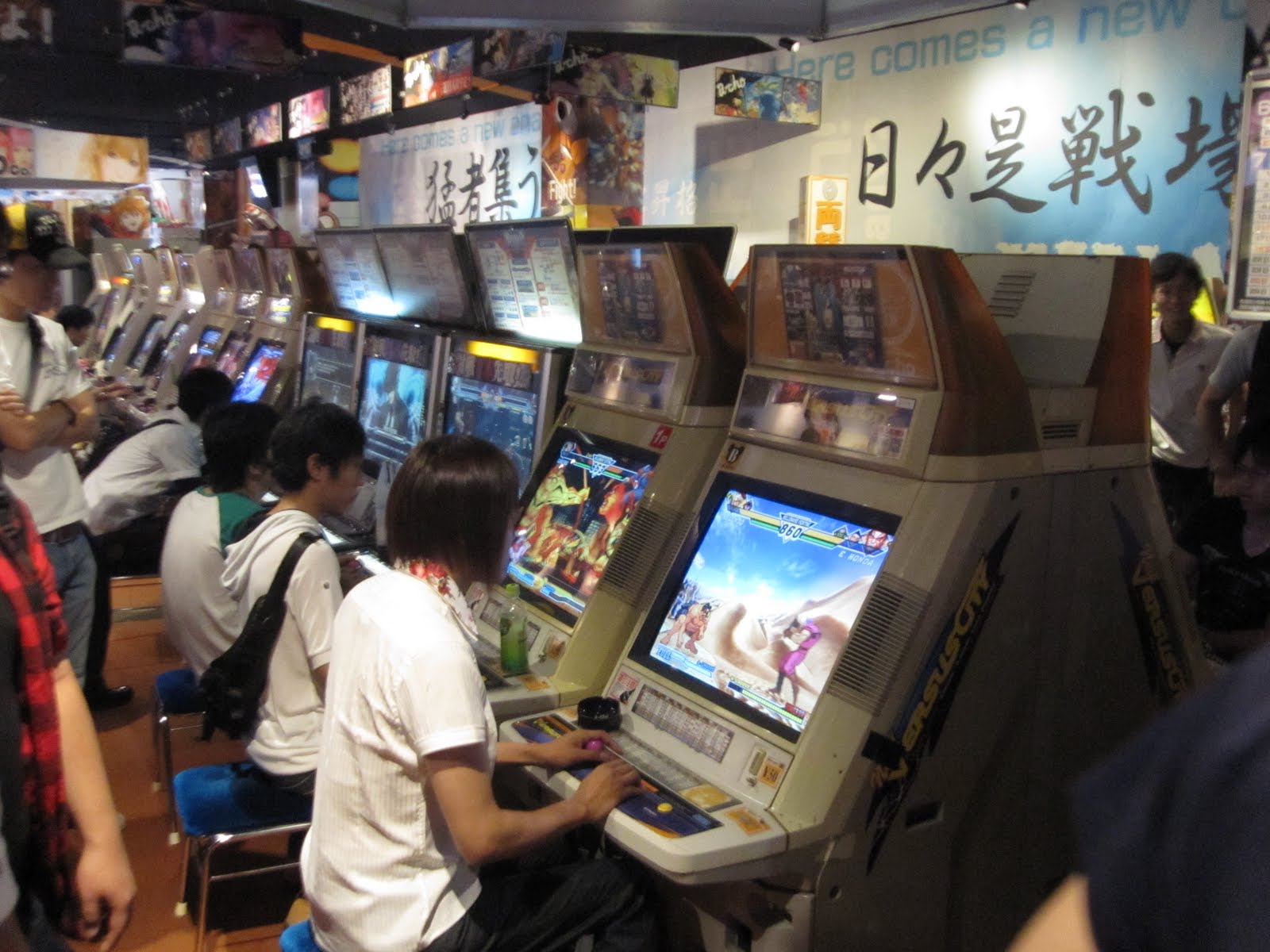
When we were all met up, we found our way back to the arcade that we thought was just a pachinko parlor. There were actually two floors of arcade games above the pachinko area, mostly filled with fighting games like Street Fighter IV and Tekken 6. There was even a small cafe area that was obviously geared towards the anime-girl-loving Japanese gamer types. I didn't play any games, but Paul played against a Japanese player in the game BlazBlue and was completely demolished. Judging by what I've seen in Japanese players, I can agree that they are much better at video games than we in the US are.

We proceeded down a road that we visited on our first trip to Kyoto to a shrine were there was supposed to be an event at 4:00PM. There were not that many people initially so we were able to get a spot on the curb, but more and more people eventually started filling in. Once again, we encountered the UCSD students, who walked by and said hi. After a while we met up with Khoa and Ken, another WPI student who lives in Japan. Soon afterwards, there was an announcement from the nearby police saying that the event was delayed until 6:00PM. It was already almost 5:00PM at that time, so we decided to head back home. There were two processions of people that went up to the shrine while we were there, but we didn't get to see the main event. Fortunately, we did get to see the parade and had a good time overall.

(Check out all the pictures from the Gion Festival here!)